|
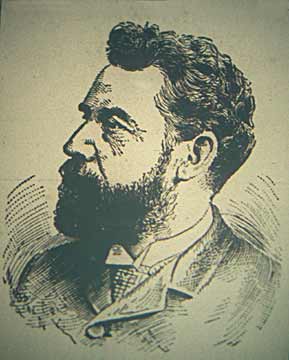
(Return to PREVIOUS PAGE or ASBURY INDEX or MAIN PAGE) JAMES A. BRADLEY AND ASBURY PARK (continues) Around the turn of the century, Asbury Park (which had become a city in 1897) began to overtake Long Branch in popularity. The loss of horse racing had been a blow to the nation's oldest seaside resort, a condition all the more serious because its wealthy population had been moving out since the early '80s, relocating itself in other communities on Ocean Avenue, the so-called "Golden Road." When in 1907 an anti-gambling bill was passed, Long Branch entered a period of decline that lasted until the 1920s. Bradley's attacks on liquor and gambling had become so conspsicuous and acerbic that he began to fear for his life. As the letter bomb was a favorite anarchical device at that time, Bradley saw to it that someone else opened his mail. Many people smirked at his suspicion, took it as just another example of his adventurous streak. Even so, how amusing could it have been to John L. Coffin, editor of the "Asbury Park Journal," on whose desk Bradley dropped his mail? "Just open that, Coffin, and see what it is," he would say before taking his leave. Coffin never found anything harmful, and, as far as can be told, Bradley never got a chance to use his loaded cane. In 1902 Bradley's power began to slip away. A battle had been raging between him and the city of Asbury Park for control of the beachfront. The city believed that its own dispensation of it would be more advantageous to progress. Three years before, Bradley had refused to sell this property to a private corporation for $500,000 dollars; but now when the city threatened to condemn his holdings and to test the legality of his ownership, he finally gave in. He sold the beachfront for a mere $100,000 dollars plus $50,000 for the sewer system. This was considered practically a gift, since the property at that time was worth about $1,000,000.
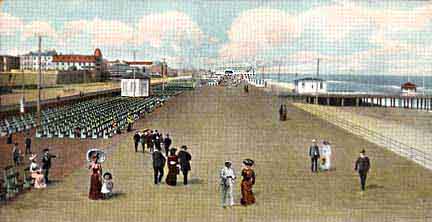
Boardwalk, c. 1900 The city rebuilt the boardwalk, constructed jetties and a new bathing plant; in 1904 Arthur Pryor, Asbury Park's bandmaster for many years, gave the first of his public concerts.
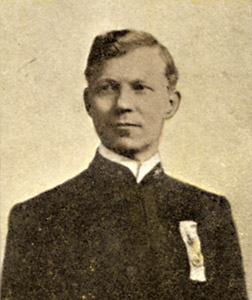
Arthur Pryor, the great trombonist, got his start in Sousa's band. The value of the city's property jumped at a surprising rate as outside capital became more interested than ever. Residential and business districts expanded. Amusements were added. The city adopted a commission form of government, after which municipal management advanced "to a degree not equalled along the Jersey shore." Now in his eighties, Bradley grew sulky and irritable; he disliked the inclusive direction that Asbury was pursuing. Occasionally he took out newspaper advertisements in which he scolded the city. Sometimes he endorsed plans only to withdraw his approval a little later. Just once did he attend a meeting of the commission government, and that was in order to give his opinions on new street grades that had been proposed. At this meeting he stated that he had wished Asbury Park to be a model for other communities and that he wanted it to "grow right." To this he added, "I want to look down from heaven and be pleased with the view." One of his regrets was that he had not made Cookman Avenue straight. Though Bradley retained extensive property holdings, he had begun to distance himself more and more from Asbury Park. "It remains for posterity to determine whether I builded wisely," he said in a philosophic tone. In these later years he paid closer attention to his land in Bradley Beach (a town named after him and whose development he started); he tended also to his brush manufacturing business in New York. Though he still possessed great wealth, he noted that he would have been a much happier man had he lent his money at interest instead of investing it in the creation of a resort. "No, summing it all up, Asbury Park to me was a financial failure. I would have been much happier in my old age had I never heard of the place." In 1905 his wife passed away. This was one of the great sorrows of his life. Throughout her residence in Asbury, Helen M. Bradley had been quietly active in charitable causes, often giving anonymously to the poor. It was said that her husband would not survive long after her death. In the spring of 1921, in the Hotel Grand, New York City, Bradley lay suffering from the ills of old age and from a bladder condition he had aggravated in a fall a few years earlier. He read the "Asbury Park Press" meticulously, and he was well aware of the preparations for the city's 50th anniversary celebration. He knew of the bronze monument that was soon going to be raised in his honor. No one had heard him utter a word about this, except once. His comment came after scrutinizing a news photo of the statue and reading the accompanying article: "I'm sorry," he sighed, barely speaking, "I'm very sorry." Precisely what he meant is uncertain. On June 6 of the same year, at 10 P.M., the physical pain he had endured in those final days ended peacefully. He was 91 years old. The finished monument to him was unveiled June 29th of that same month and stands today in its original spot in Asbury's Atlantic Square, across from Convention Hall. It is said that the full extent of Bradley's lifetime charity never will be known. In passing he left bequests to nearly every church in Asbury Park, to hospitals, to benevolent societies, and to many employees of his brush company. When, a year after his death, his real estate holdings finally came on the market, Asbury embarked upon a decade of marvelous growth, the like of which had not been seen since the early days. (NT)
EXTRA: See the "annotated" BRADLEY MONUMENT Return to PREVIOUS PAGE or ASBURY INDEX or MAIN PAGE |
 |